Adam Herring Art and Vision in the Inca Empire
21 May 2020
What Machu Picchu can tell us near COVID-19
The coronavirus arrives in Peru, with historic irony
Adam Herring
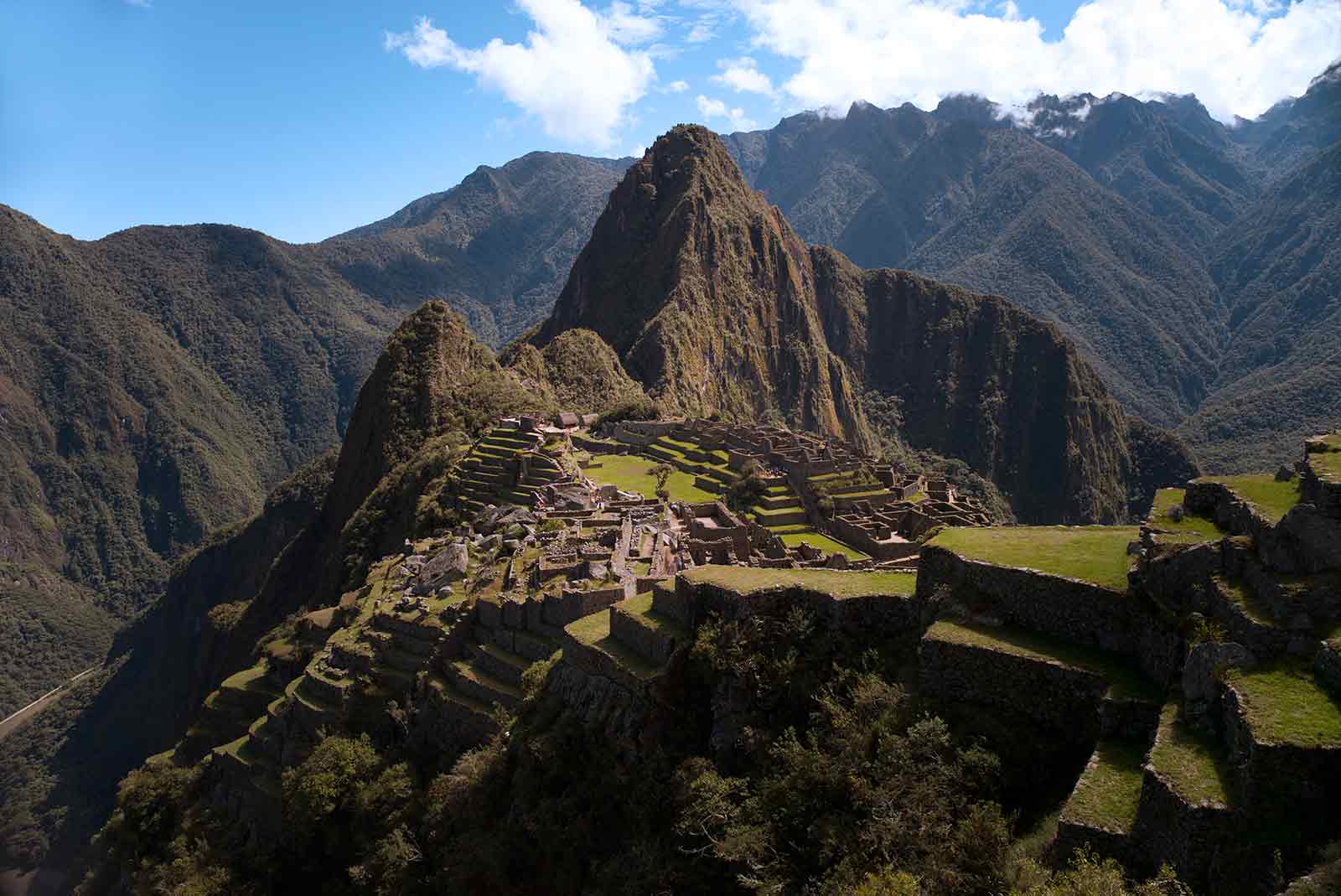
Machu Picchu, congenital by Inca elites in large measure to escape contagion in their capital urban center of Cuzco. Photo Adam Herring.
Madre de piedra, espuma de los cóndores (mother of stone, semen of condors): that was Pablo Neruda'southward impression of Machu Picchu, the hot literary take of 1950.[ane] Machu Picchu has inspired poetic, philosophical, and patriotic works over the years. More recently, however, it has likewise invited fears of ending, as reports and opinion pieces from around the world take denounced Peru's shortsighted and venal program to build a new airport near the site. President Martín Vizcarra of Republic of peru "is determined to destroy this sacred place," read an op-ed in the New York Times this past year.[2] That project would, the writer wrote, "irreparably damage the heartland of the Inca civilisation."
No question, Machu Picchu is in danger. An ancient ruin faced with imminent ruin: that statement'due south double edge should tell u.s.a. something most our own thinking. The truth is we've long made American antiquity the natural home of disaster. Our scientists and historians offering up and so many examples, from the dinosaur-killing meteor strike at Chicxulub, Yucatan, to "the Maya droughts" that extinguished the glittering cities of the Central American rainforest. Ancient catastrophes offer convenient proxies for our own political struggles and societal failures. We can't help merely map the calamities of our fourth dimension onto the past. We log on and read down the folio. Disaster sells.
Of course, the scientists' findings are true, and the preservationists' warnings are warranted. Still, we might practice well to temper our racing fascination with sudden ruin. Throttle back on the catastrophism, and the past quietly speaks in its ain voice. By allowing it to do then, aboriginal monuments like Machu Picchu brainstorm to annotate more incisively on our own calamities.
This all came to mind in early March as the World Health Organization reported the first confirmed example of COVID-19 in Peru. Peru's patient nada was a xx-five-yr-former who had returned from travel in France, Spain, and the Czechia. While I tin can't say for certain, the unfortunate victim has all the appearances of a young person back from the bucket-list tour of Paris, Barcelona, and Prague. Machu Picchu is hardwired into that same touristic circuit, one more attraction on the same grand bout. The site is visited by upward of i.5 million tourists per year, most of them young people who make the long trip to the Andean nation from abroad. Forth with the floes of Republic of iceland and Thailand'south beach towns, it is some other day's entry for the motorcycle diary. What brought COVID-nineteen to Peru was global youth civilisation, a cosmopolitan twenty-something dorsum from a world run a risk. On the airtight loop of the global pilgrimage road, what goes around comes around: to my way of thinking, information technology was Machu Picchu that drew Peru into the coronavirus pandemic.
The Inca lords of Machu Picchu might accept chuckled. Those aristocrats built Machu Picchu in large measure to escape runaway contagion in their uppercase city of Cuzco. Machu Picchu was in fact a "retreat," a country estate intended for the Inca ruler'southward occasional stay. The male monarch and his retinue were Machu Picchu'due south summer people. The months of January through March are loftier summer in the Andes; a time of strong sunday and heavy rains, it is a beautiful season, if also miserable. Plants come to life and burgeon, though so do microbes that had lain dormant over the previous months of common cold and dry out. Summertime in the high Andes is the flu season. Trust me. In the rainy month of January, anybody is sick.
Back in Cuzco, the monsoon'southward arrival saw the Inca country shift into rhetorical high gear. Cuzco was the capital of Tawantinsuyu, "Realm of the Four Quarters," an empire of cosmic design that extended to the far reaches of the Andean earth. The Inca leadership were the Andes' upstarts, tardily arrivals who harbored ambitions of pan-Andean sovereignty. In times of trouble, their universal capital was another xenophobic hill town, an island in a sea of enemies: universal Cuzco now reverted to Cuzco against all. Ordinary Incas engaged in weeks of ritual meant to expunge sickness from the city. Citua, "radiance," was the ritual period'due south proper noun, as if the city were a gleaming gem that threw off colored light, though in its performance, the overriding image of Citua was that of black-h2o runoff. Citua was less Cuzco'due south slap-up radiance than a grim deep-clean, a grand flushing of bodily effluent.
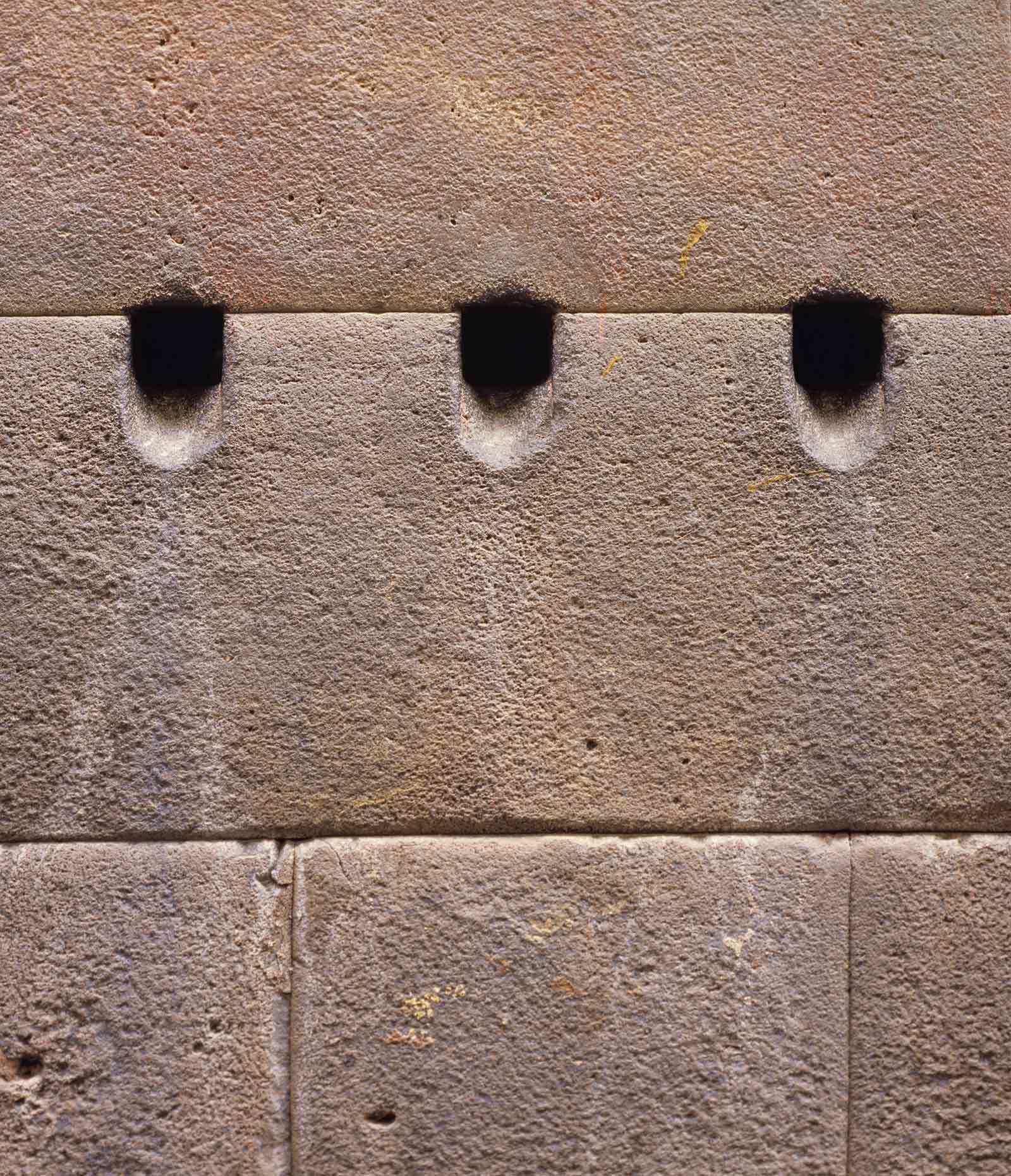
Dregs of the sun: a drain in the n section of the perimeter wall of Inca Cuzco's oracular shrine, the Coricancha. Inside the temple, the sunday-god spoke to Inca leaders: "He answered whatever they asked," one Andean noble later recalled. The solar divinity lived amidst gleaming metallic effigy-statues, apartments faced with gold, and sparkling fountains. As elegant as all the rest, this drain evacuated waste product water from the temple precinct. Photograph Adam Herring.
In their homes, women mopped their floors to purge the house of affliction, cursing as they pushed muck out the door. Immature men were then assembled at the centre of the city. They were to finish the job the housewives had started. Armed for war, they were ordered to quick-march to the four corners of the Andean world. They raced down the Incas' fine highways, chanting and singing. The young men performed "runoff": they were fast-running rivers, turbid and noisy—only more than remarkable, for they could flow upward Andean mountain slopes as well as downwards. They washed Cuzco'south seasonal illness to the Amazonian forests of the east, the Pacific in the due west, the deserts of the north, and Patagonia's mountain ranges in the south.
In the capital letter, the Inca rank and file had now gorged themselves with the political crimson meat of military spectacle. Epidemiologists today would point out that the Incas' leaders were taking advantage of ii facts of seasonal flu—on the i hand, its high morbidity (high rate of infection), and on the other, its low mortality (low rate of death). As well as a third fact, the flu'southward relatively brusque stay. Seasonal infections elevator from a population in much the aforementioned way they come up on, suddenly just predictably. (I phone call it flu, though the issues that afflicted Cuzco each twelvemonth was non strictly flu—that particular virus arrived in the western hemisphere later 1492.)
That was the rainy flavor in the populous, sneezy majuscule. From their perch at Machu Picchu, the rex and his entourage rode out the flu-season in comfort, enjoying the spectacular views. Removed from the capital, the ruler and his retinue were protected from his subjects' contagion. A human shield of servants and retainers surrounded the Inca king—litter-bearers, bodyguards, attendants. His wearable was handled the way medical quarantine units treat patients' gowns and bedclothing now: habiliment in one case, then burn down. The Spanish witnesses who saw these elaborate protocols of social distancing were dumbfounded with admiration.
And similar any trophy property, Machu Picchu could not support itself. Merely vii hundred or so laborers lived at the site year-circular, simply the estate could not produce plenty grain to feed them. For all their soaring beauty, Machu Picchu'southward cliffside terraces only amounted to about x acres of arable land. Food was hauled in from elsewhere on llamas and porters' backs. After the European invasion, Machu Picchu lapsed into abandonment and historical obscurity. The place had petty purpose absent Inca royal privilege, and niggling means of survival without it. Defenseless in the grinding gears of social hygiene and ecology sustainability, the flu-season refuge of Machu Picchu soon became a silent monument to ecological overshoot. If a monument nosotros can't visit in the near term, it remains seductive clickbait for the era of meridian oil.
Adam Herring teaches fine art history in the Meadows School of the Arts at Southern Methodist University in Dallas. The recipient of a Guggenheim Fellowship in 2017, he is writing a book on art and environmental in Inca Peru.
If you've enjoyed the free manufactures that we offering on our site, please consider subscribing to our nonprofit magazine. Y'all become twelve online issues and unlimited access to all our archives.
Source: https://www.cabinetmagazine.org/kiosk/herring_adam_21_may_2020.php
0 Response to "Adam Herring Art and Vision in the Inca Empire"
Post a Comment